
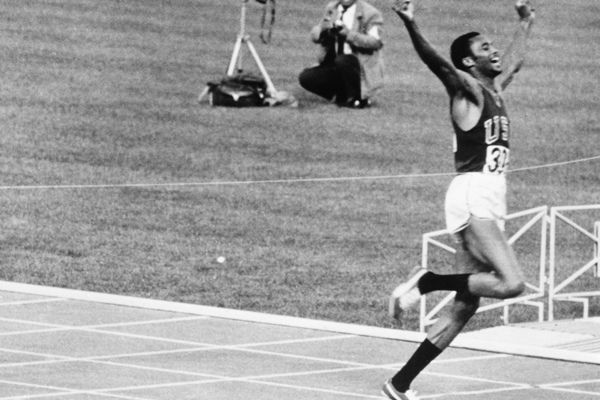
Smith Handed His Place in History: Courage, Controversy, and an Unbreakable Legacy
History rarely delivers defining moments with quiet subtlety. More often, it arrives in a sudden flash of lightning—a single action, a courageous stand, or a monumental achievement that forever changes the trajectory of a life and the consciousness of a generation. When Tommie Smith stood atop the Olympic podium in Mexico City in 1968, raised a black-gloved fist into the thin autumn air, and bowed his head during the national anthem, he was handed his place in history. It was a moment of supreme athletic triumph inextricably bound to radical moral conviction.
Yet, the story of how an individual is “handed their place in history” is never purely about a single photo or a fleeting second in time. It is about the years of relentless discipline that built the athlete, the systemic pressures that demanded a voice, and the immense personal cost that followed. Here is an in-depth look at how Tommie Smith—and figures like him—carved out an enduring legacy that continues to resonate across sports, politics, and human rights.
1. The Making of a Legend: Speed, Power, and Purpose
Before he became a global symbol of civil rights activism, Tommie Smith was simply one of the most gifted sprinters the world had ever seen. Born in Clarksville, Texas, and raised in California’s Central Valley, Smith grew up working in cotton fields—a background that forged an extraordinary work ethic and a deep awareness of racial inequality in America.
At San Jose State University, under the guidance of legendary track coach Bud Winter, Smith helped transform the program into “Speed City.” Standing 6-foot-3 with a fluid, bounding stride, he rewrote the record books across multiple distances. By the time he qualified for the 1968 Mexico City Olympic Games, he held or shared 13 world records simultaneously—a feat of sprinting dominance that remains staggering by modern standards.
His athletic culmination came on October 16, 1968, in the 200-meter final. Despite suffering a groin injury in the semifinals, Smith accelerated down the home stretch, tearing past the field to win the gold medal in a world-record time of 19.83 seconds—becoming the first human to officially break the 20-second barrier in the 200-meter dash.
2. The Silent Gesture That Echoed Across the Globe
While the world-record victory secured Smith’s athletic credentials, his actions during the medal ceremony defined his life. Alongside American teammate John Carlos (who took bronze) and Australian sprinter Peter Norman (who took silver), Smith orchestrated a silent, peaceful protest designed to highlight racial injustice and economic inequality back home in the United States.
Every element of their appearance on the podium carried deliberate, symbolic weight:
- The Raised Black-Gloved Fists: Smith (right fist) and Carlos (left fist) raised their hands to represent Black power, unity, and solidarity with oppressed peoples worldwide.
- Black Socks Without Shoes: Symbolized the persistent poverty facing African American communities.
- Black Scarf and Beads: Worn by Smith and Carlos respectively to honor victims of lynching and racial violence.
- Olympic Project for Human Rights (OPHR) Badges: Worn by all three athletes—including Australia’s Peter Norman—to show unified support for universal human rights.
“If I win, I am American, not a Black American. But if I did something bad, then they would say I am a Negro. We are Black and we are proud of being Black. Black America will understand what we did tonight.”
— Tommie Smith, October 1968
3. The Immediate Backlash and Exile
The reaction from the international sporting establishment and the American media was swift, punitive, and severe. International Olympic Committee (IOC) President Avery Brundage demanded that Smith and Carlos be suspended from the U.S. team and banned from the Olympic Village. When the U.S. Olympic Committee initially resisted, Brundage threatened to ban the entire U.S. track and field team. The athletes were promptly sent home.
Upon returning to the United States, Smith and his family faced intense hostility:
- Death Threats and Ostracization: Smith received constant death threats, and his family home was targeted.
- Professional Blacklisting: Despite holding a master’s degree and world athletic records, Smith struggled for years to find stable employment.
- Personal Toll: The immense pressure and social isolation contributed to severe emotional strain and the breakdown of his marriage.
For decades, the sporting world attempted to erase Smith’s achievement, treating his podium stance as an embarrassing breach of athletic decorum rather than a courageous act of moral leadership.
4. The Long Arc of Vindication: Reclaiming the Narrative
History has a way of correcting its own record. As time passed and the struggle for civil rights gained broader historical appreciation, the perception of Smith’s gesture underwent a dramatic shift. What was once condemned as unpatriotic came to be recognized as one of the most powerful, principled acts of peaceful protest in modern history.
Key moments in the vindication of Tommie Smith include:
- San Jose State Statue (2005): San Jose State University erected a 22-foot statue commemorating the 1968 protest, honoring Smith and Carlos as courageous alumni.
- Arthur Ashe Courage Award (2008): Smith and Carlos were jointly presented with the Arthur Ashe Courage Award at the ESPYs, recognizing their lifelong impact.
- Presidential Recognition (2016): President Barack Obama welcomed Smith and Carlos to the White House, praising their courage and noting that their protest paved the way for future generations of athlete-activists.
- USOPC Hall of Fame Induction (2019): The U.S. Olympic and Paralympic Committee formally inducted Smith and Carlos into its Hall of Fame, acknowledging the historic significance of their podium moment.
5. Lessons for Modern Athlete-Activists
The story of Tommie Smith being handed his place in history offers critical lessons for modern athletes who use their platforms to address political and social issues:
- Excellence Earns the Platform: Smith’s message resonated because it was delivered from the top step of the Olympic podium. World-class performance creates the audience.
- Principles Outlast Popularity: True leadership often requires standing alone when the immediate political climate is hostile. Time frequently vindicates those who stand on the side of justice.
- Protest Requires Strategy and Precision: The 1968 podium protest was not a random outburst; it was a deeply symbolic, peaceful, and well-thought-out message that required no words to communicate across language barriers.
The Takeaway: A Legacy Cast in Bronze and Courage
Tommie Smith was not merely handed a spot in history by chance—he earned it through unparalleled athletic skill and secured it through unyielding moral conviction. By sacrificing his personal comfort, immediate career prospects, and public standing for a cause greater than himself, he transformed a 20-second sprint into an immortal symbol of human dignity.
His story serves as a timeless reminder that while athletic records are eventually broken, courage in the face of injustice remains forever unbroken!